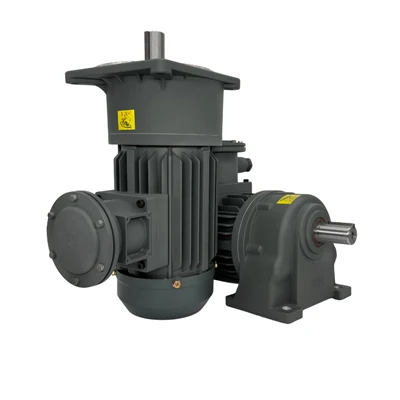
If you’ve ever hung around industrial gear talk, you’ve probably heard the term “inline helical gear boxes” thrown around way more than straight-cut spur gear boxes lately. As someone who’s spent the last decade building these boxes for companies that make everything from conveyor lines to packaging machinery, I get asked all the time: why helical? Why not just go with the cheaper, simpler spur gears? Let’s break this down like I’m chatting with a guy who’s got a line on a project and wants to know exactly what he’s paying for. No stuffy engineering jargon that makes you reach for a coffee – just real, on-the-ground advantages that make helical gear boxes worth your money, every time. Inline Helical Gear Boxes

First off, let’s get one basic fact straight that most people miss: helical gears aren’t some fancy, overcomplicated upgrade. They’re shaped like a slanted spiral, right? Whereas spur gears have straight teeth that meet the other gear’s teeth dead-on, like two flat pieces of wood rubbing together. That angle is the secret sauce, and it changes how the whole gear set works from the very first spin. The biggest win here? Noise. If you’ve ever stood next to a spur gear box running at full speed, you know that high-pitched whine isn’t just annoying – it’s a signal that those teeth are slamming into each other hard, every single second. Helical gears? Their teeth engage gradually, like two hands sliding together instead of clapping. That means no sudden impact, no high-frequency vibration, and way less noise. I had a customer a few months back who was switching from spur gears on a conveyor system for a major grocery distribution center. Their old setup was hitting 85 decibels – right at OSHA’s limit for 8-hour shifts, and their night shift crew was complaining about headaches by 2 a.m. Switched to our inline helical gear boxes, and noise dropped to 72 decibels. That’s quieter than a normal conversation. No more noise complaints, no need for expensive sound-dampening panels, and their crew is way happier. That’s not a small win – that’s money saved on compliance, and happier employees who show up to work less drained.
Next up: durability and load handling. Let’s do quick math here that makes sense. Each tooth on a spur gear takes the entire load of whatever the machine is pushing or pulling, all at once. Imagine carrying a 50-pound bag of sand with just one hand – that’s what a spur gear tooth does, non-stop. Helical gears? The load is split across multiple teeth at the same time, like carrying that same 50-pound bag with two hands. Because the teeth are slanted, when they start meshing, they don’t just hit and take all the force at once. A typical inline helical gear box has 2-3 teeth engaged at any given time, compared to just one or sometimes less for a spur gear box. That means less stress on each individual tooth, less wear and tear, and way longer life. I’ve got customers who’ve been running our helical boxes for 12 years straight with no major gear replacement – and that’s with 12-hour days, 6 days a week. Their old spur gear boxes were dying every 3 years, costing them thousands in replacement parts and downtime. Downtime is the silent killer for manufacturers, right? If your line goes down for a day, that’s lost production, missed deadlines, maybe even penalties from your customers. Helical gear boxes cut downtime because they last longer, and they don’t overheat as easily. Wait, yeah – overheating is another big one. Spur gears generate a lot of friction from that sudden impact, and friction turns into heat. Too much heat breaks down the lubricant inside the gear box, which makes wear even worse, like a snowball effect. Helical gears have less friction, so they run cooler. That means you can run them longer at higher loads without having to shut down for cool-downs, and the lubricant lasts longer too – sometimes twice as long as in a spur box. Less oil changes, less maintenance, less money spent on upkeep. It’s not just about the gear itself; it’s all the little things that add up over time.
Wait, let’s talk about efficiency too – that’s a huge one that gets overlooked. A lot of people think all gear boxes are about the same when it comes to how much power they actually deliver to your machine. But here’s the thing: every time you have energy lost to friction, vibration, impact, that’s power wasted. Helical gears are way more efficient than spur gears, especially at higher speeds and under heavy loads. A good inline helical gear box has around 95-98% efficiency per stage, compared to 90-95% for spur gears. Let’s put that in real numbers: if you’re running a 10-horsepower motor, a helical box is delivering 9.7 horsepower to your machine, versus 9 horsepower for a spur box. That’s 0.7 extra horsepower you’re paying for that you could be using for your production. Multiply that by 24 hours a day, 7 days a week, and that’s real electricity bills going down. I had a customer in the automotive parts industry who did the math on switching from spur to helical. Their annual electricity cost for their gear systems dropped by almost $18,000. That’s not chump change – that’s a new piece of equipment every year, or a raise for their maintenance team. Efficiency isn’t just a “nice to have” – it’s actual money in your pocket, every single month.
Now, let’s get specific about inline helical gear boxes, not just helical gears in general. Inline means the input shaft and output shaft are on the same center line, right? That makes them perfect for applications where you need a straight, compact fit. Think about conveyor systems, machine tools, packaging lines, even industrial mixers. You don’t have to change the layout of your machine to fit an inline helical box – it slots right in where your old spur box was. But wait, the helical design fixes a common problem with inline gear boxes: thrust load. Straight-cut spur gears generate a side-to-side force (thrust) when they run, especially under load. That force puts extra stress on the bearings and the gear shaft, which means you need bigger, more expensive bearings, and the whole setup can wear out faster. Helical gears? They generate thrust load too, but here’s the trick: in an inline helical gear box, you can pair them with equal and opposite helical gears (one left-handed, one right-handed) that cancel out almost all that thrust. No more extra stress on the bearings, no need for oversized parts, and the gear box runs smoother. That’s a game-changer for inline applications, because you get the benefit of the helical gear’s strength and low noise, without the hassle of thrust load messing up your setup. I’ve had customers tell me they tried other helical gear brands that didn’t handle thrust load right, but our inline design fixes that – no more shaft bending, no more premature bearing failure.
Another thing: versatility. Inline helical gear boxes work across a way wider range of speeds and torque levels than most other gear box types. Need a high-torque setup for a heavy conveyor that moves pallets all day? We can build that. Need a high-speed setup for a packaging machine that puts 500 bottles a minute on a line? We’ve got that too. Unlike worm gear boxes, which are efficient at low speeds but bad at high speeds, or bevel gear boxes which are better for changing direction, inline helical boxes handle both high torque and high speed like a champ. And they’re easy to customize, too. Need a specific shaft size, or a different mounting pattern, or a special lubricant for food-grade applications? We can adjust that. A lot of our customers come to us because their old gear boxes were one-size-fits-all, and they needed something that fit exactly their machine. Inline helical boxes give you that flexibility, without sacrificing any of the advantages we’ve talked about.
Wait, let’s talk about real-world use cases to make this concrete. I recently worked with a small manufacturing shop that makes custom woodworking machinery. They were using spur gear boxes on their planers, but the noise was so bad that their workers had to wear ear protection all day, and they kept having to replace gear boxes every 2 years because the teeth were wearing down from the constant load. Switching to our inline helical gear boxes cut the noise by 15 decibels – so now their workers only need ear protection for loud sanding operations, not the planers. They’ve gone 3 years without replacing any gears, and their electricity bill for that section of the shop dropped by $1,200 a month. That’s a small business owner looking at an extra $14,400 a year in his pocket, just from switching gear boxes. That’s not a hypothetical – that’s a real customer, real numbers, real results.
I know what some of you are thinking: “Helical gear boxes are more expensive upfront, right? So why would I pay more now to save money later?” Yeah, that’s a valid question. But let’s do the total cost of ownership math, not just the upfront price. A basic inline spur gear box might cost you $500. Our inline helical box with similar specs? Maybe $750. That’s $250 more upfront. But wait – the spur box lasts 3 years, so every 3 years you’re paying another $500, plus $200 a year in maintenance, plus the extra $100 a month in electricity. Over 10 years, that’s: 3 sets of spur boxes ($1,500) + $2,000 maintenance + $12,000 electricity = $15,500 total. The helical box? It lasts 12 years, no major maintenance, $20 a month less electricity. Over 10 years, that’s $750 + $200 maintenance + $2,400 electricity = $3,350. That’s a difference of over $12,000. That’s not a small number – that’s the cost of a new truck, or a full new piece of equipment. The upfront cost is higher, but the long-term savings are massive. I never try to hide that upfront price difference from customers – I lay out that math for them, and 9 times out of 10, they go with the helical box. Because when you’re running a business, what matters is total cost, not just the first ticket price.
Now, let’s clear up a common misconception: helical gears aren’t prone to jamming or binding, even though their teeth are slanted. Modern manufacturing processes mean we cut those teeth to super tight tolerances, so they mesh perfectly without any grinding or binding. I’ve had customers tell me they heard old stories about helical gears locking up, but that’s from decades ago when machining was less precise. Today’s inline helical gear boxes are built with CNC-cut teeth, balanced shafts, and high-quality bearings, so they run smoother than a well-oiled door hinge. No binding, no weird vibrations, just consistent power output day in and day out.
So putting it all together: inline helical gear boxes give you lower noise, longer life, less downtime, higher efficiency, lower total cost of ownership, and versatility for a huge range of applications. They’re not a gimmick – they’re a proven upgrade that makes sense for anyone who relies on industrial gear systems to keep their business running. At the end of the day, gear boxes are the unsung heroes of manufacturing. They’re not the flashy robot arms or fancy conveyor belts, but if your gear box goes down, your whole line stops. Investing in a quality inline helical gear box isn’t just buying a part – it’s investing in less headaches, more uptime, and more money in your business’s bank account.
If you’re currently dealing with noisy gear boxes, frequent replacements, or high energy bills from your setup, I can help. We build inline helical gear boxes tailored to your exact needs – no one-size-fits-all, no confusing jargon, just honest advice and a product that’s built to last. Hit us up to chat about your project, share your specs, and we can put together a quote that makes sense for your budget and your goals. Don’t settle for gear boxes that cost you more in the long run – make the switch to helical, and see the difference for yourself.
RF Hypoid Gear Motor References
Shigley, J. E., & Mischke, C. R. (2001). Standard Handbook of Machine Design. McGraw-Hill.
Townsend, D. P. (1992). Gear Noise and Vibration. Marcel Dekker, Inc.
American Gear Manufacturers Association. (2019). AGMA Standard for Inline Helical Gear Units. AGMA Publication 6010-F19.
GuangDong Ruisico Transmission Technology Co., Ltd.
Guangdong Ruisico Transmission Technology Co., Ltd. is one of the most reliable inline helical gear boxes manufacturers and suppliers in China, also supports customized service. Welcome to buy durable inline helical gear boxes made in China here and get quotation from our factory. For price consultation, contact us.
Address: No. 70, Anjing Road, Shengfeng Community, Xiaolan Town, Zhongshan City
E-mail: info@risc-drive.com
WebSite: https://www.risc-motor.com/
