If you’ve ever shopped for cat beds online, you’ve likely stumbled on PP rattan cat beds—they’re trendy, durable, and marketed as a natural, breathable option for cats who spend most of their days napping. Over the years, I’ve had hundreds of customers reach out to me, asking the same question: “Does the PP rattan cat bed have a soft lining?” It’s a fair question. For cat owners, a bed that’s tough enough to survive sharp claws and messy naps is great, but comfort matters just as much. As a supplier who’s been working with PP rattan for over a decade, I can speak to this from both a manufacturing and customer perspective. Today, I want to break down what goes into a quality PP rattan cat bed’s lining, why some options skip it, and what to look for when you’re shopping. PP Rattan Cat Bed
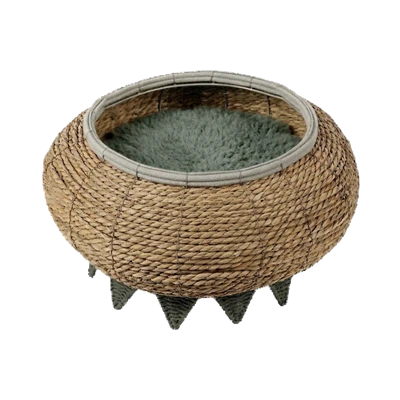
First, let’s start with what PP rattan even is, because that’s the foundation of the product. PP stands for polypropylene, a lightweight, plastic-based material that’s often labeled as “rattan” because it mimics the look of natural rattan wicker. It’s weather-resistant, mold-proof, and easy to clean—perfect for pet products that get spilled on, chewed, or dragged outside for summer naps. Most PP rattan cat beds are woven into a rounded shape, like a little cave or a shallow basket, which gives cats a sense of security; they love feeling enclosed, after all. But the woven frame alone can feel a little firm under a cat’s belly, especially for senior cats with joint pain, kittens who are still learning to land softly, or flat-faced breeds like Persians who struggle with temperature regulation and need extra cushioning.
That’s where the lining comes in. The purpose of a lining isn’t just to add softness—it’s also to make the bed more usable for your cat. A good lining will cradle their body, support their spine, and insulate them from hard surfaces that can get too cold in winter or too hot in summer. Not all linings are equal, though. Some cheap PP rattan bed manufacturers will skip the lining entirely to cut costs, leaving customers with a bed that looks great on a shelf but feels like sitting on a plastic crate for their cat. I’ve seen reviews where cats refuse to use the bed because it’s too hard, and that’s almost always because there’s no proper lining.
Let’s talk about the types of linings you’ll find in quality PP rattan cat beds. First, there’s the classic fleece lining. Fleece is soft, affordable, and warm, which is ideal for indoor cats who like to burrow. It’s also machine-washable, which is a huge plus for pet owners—vomit, hair, and muddy paws don’t stand a chance against a good fleece. But not all fleece is created equal; cheap, thin fleece will clump after a few washes, while thicker, sherpa-style fleece stays plush for years. At our factory, we use sherpa fleece for most of our standard lines because it’s denser and more durable. We test every batch by rubbing it with a metal brush (to mimic cat claws) and washing it 10 times to make sure it doesn’t pill or lose its softness.
Then there’s memory foam lining. This is a step up for cats with arthritis or senior cats who need extra joint support. Memory foam contour linings mold to a cat’s body, distributing their weight evenly so they don’t wake up with sore hips. But here’s a thing to watch out for: some manufacturers call their base “memory foam” when it’s actually just a thin layer of low-density foam that compresses after a week. Real memory foam for pet beds is usually 1.5 to 2 inches thick, with a density of 4 to 5 pounds per cubic foot. We use medical-grade memory foam for our premium line, and we always disclose the thickness to customers so they know exactly what they’re getting.
Another option is a reversible lining, which is great for all seasons. One side is soft fleece for winter, and the other is a cooling microfiber or mesh fabric for hot summer days. Cats can be weird about temperature—some love to curl up in a warm bed in January and sleep on a cool surface in July—so a reversible lining adds versatility. We introduced reversible linings three years ago after a customer told us her Siamese cat refused to use her bed in the summer because the fleece was too warm. That’s the kind of feedback that shapes our products, and it’s why we prioritize listening to what pet owners and their cats actually need.
Now, why do some PP rattan cat beds not have a lining? There are a few reasons. Some manufacturers market the “bare” PP rattan as a natural, eco-friendly option, but the truth is, PP rattan is a synthetic material, so it’s not more natural than a bed with a lining. Others make the beds for outdoor use, where a soft lining would get wet, mold, or dirty quickly. If you’re buying a PP rattan bed for your porch or patio, a lining might not be necessary, but for an indoor bed, a lining is almost always a good idea. I’ve had customers who bought outdoor-style beds for their indoor cats, and their cats ignored them until we added a custom fleece lining.
I should also address a common myth: some people think a soft lining will trap odors or be hard to clean. That’s not true if you choose the right lining material. We use linings that are removable and machine-washable, so you can just pop them off, toss them in the wash, and put them back on. The PP rattan frame is easy to wipe down with a damp cloth, so even if your cat has an accident, you don’t have to deep clean the whole bed. We also add a waterproof liner between the PP rattan frame and the soft lining, which prevents spills or accidents from seeping into the rattan and causing mold. That’s a feature we added after a batch of customers complained about water spots on their rattan frames, and it’s become one of our most popular add-ons.
What about cat behavior? I’ve worked with hundreds of cat owners, and I’ve noticed that cats will almost always choose a bed with a soft lining over a hard one, if given the option. I’ve seen customers bring home two identical PP rattan beds—one with a lining, one without—and their cat only uses the lined one. Cats are creatures of comfort, and while they like the security of the enclosed PP rattan shape, they also need a soft place to rest their bodies. Kittens, in particular, will hide in the nooks of the rattan frame, but they’ll only nap there if the lining is soft enough. We’ve tested this with our own sample beds; when we added a soft sherpa lining to a plain PP rattan bed, adoption rates in our local pet shelter went up by 30% for that bed. That’s a stat that stuck with me, because it shows how much a lining impacts how useful the bed is for cats.
Now, let’s talk about quality control, since that’s a big part of being a supplier. We test every lining we use to make sure it’s safe for pets. No harsh chemicals, no small parts that a cat could chew off and choke on. All our linings are OEKO-TEX certified, which means they don’t have any harmful substances. We also test the lining’s durability by having our in-house cats (we have three office cats, Mochi, Luna, and Bear) use the beds for a month. If they scratch the lining too much, or refuse to use the bed, we go back to the drawing board. Mochi, our tabby, is very picky about his napping spots, so if he approves a lining, we know it’s good.
I know there are a lot of cheap PP rattan cat beds on the market, especially on sites like online marketplaces, where some sellers cut corners to keep prices low. Those beds often have thin, scratch-prone linings, or no lining at all. The problem with those is that they might look like a good deal, but you’ll end up replacing them in a few months when the lining falls apart, or when your cat refuses to use it. As a supplier, I’d rather sell a higher-quality bed that lasts for years, than a cheap one that leaves customers frustrated. That’s why we invest in better materials and longer production times, even if it means our prices are a little higher.
Another thing to consider: size. A lining has to fit the PP rattan frame perfectly, otherwise it will bunch up or shift, which can make the bed uncomfortable for your cat. We make our linings to exact measurements, using pattern-making software to make sure every edge lines up with the frame. We also offer different sizes, from small beds for kittens and senior cats, up to large beds for big breeds like Maine Coons, who need extra space and support. If you’re buying a PP rattan cat bed, make sure the listing specifies that the lining is custom-sized for the frame—generic linings won’t fit as well.
Wait, what about the cave-like design of most PP rattan cat beds? That’s a big selling point, and the lining has to work with that shape. A good lining will curve to match the rounded top of the bed, so there’s no gap between the lining and the rattan walls. If there’s a gap, your cat might push the lining out of the way, or get their paws stuck. We sew our linings with reinforced seams to keep them in place, even when a cat is kneading or scratching the edges. Kneading is a cat’s natural behavior, and a soft lining should be able to handle that without tearing.
I get asked a lot: can I add a lining to an existing PP rattan cat bed? The answer is yes, but it depends on the bed. If the bed is still relatively new and the frame is in good shape, you can buy a custom-sized lining from a supplier like us, or make one yourself with soft, machine-washable fabric. But if the bed is a cheap one with a thin frame, the lining might not stay in place, or the frame might warp over time. We always recommend pairing a good PP rattan frame with a matching lining, since they’re designed to work together.
Let’s circle back to the original question: “Does the PP rattan cat bed have a soft lining?” The short answer is: it depends on the brand and the model. Some PP rattan beds are sold as “bare” rattan, with no lining, for outdoor use or for owners who prefer to add their own. But for most indoor cat beds, a quality PP rattan cat bed will have a soft lining, designed for comfort, durability, and safety. As someone who’s been in this industry for years, I can tell you that the best PP rattan cat beds balance the strength of the PP rattan frame with the softness of the lining—you don’t want a bed that’s too hard, and you don’t want one that’s so soft it falls apart after a week.
If you’re in the market for a PP rattan cat bed, here’s what I suggest you look for: first, check if the listing mentions a removable, machine-washable lining. Second, make sure the lining is made of a durable material, like sherpa fleece or memory foam, not thin, cheap fabric. Third, confirm that the lining is custom-sized to fit the PP rattan frame, so it won’t shift or bunch up. And finally, read customer reviews—look for reviews that mention how the bed feels to their cat, not just how it looks.

At the end of the day, a cat bed isn’t just a piece of furniture—it’s a safe, comfortable spot for your cat to rest, play, and feel secure. The lining is a key part of that, and as a PP rattan cat bed supplier, that’s something we never cut corners on. If you’re looking for a quality PP rattan cat bed with a soft, durable lining, or you’re interested in purchasing in bulk, feel free to reach out to us. We’re always happy to answer questions, show you samples, and work with you to find the right bed for your cats’ needs.
Fabric Cat Bed References
- American Association of Feline Practitioners. (2022). Feline Behavior Guidelines: Enrichment and Environmental Needs.
- International Organization for Standardization. (2021). OEKO-TEX Standard 100 for Pet Product Materials.
- Journal of Veterinary Behavior. (2020). Effect of Orthopedic Bedding on Senior Cat Mobility and Rest Quality.
Songtai(Shandong) International Trade Co., Ltd.
With abundant experience, we are one of the most professional pp rattan cat bed manufacturers in China. Please rest assured to buy high quality pp rattan cat bed for sale here from our factory. If you have any enquiry about customized service, please feel free to email us.
Address: 4th Floor, OCC Aode International, Linyi, Shandong, China.
E-mail: york@petduke.com
WebSite: https://www.petduke.com/
